Foz do Iguaçu | Puerto Iguazú

One of the world’s greatest waterfalls and largest dams at the meeting of three countries

Iguazu is the confluence of rivers and countries alike, with the region being known as the Triple Frontier, as it is where Brazil, Argentina and Paraguay all come together. There are two main attractions in the region: the mighty Iguazu Falls – the largest waterfall system in the world – and the Itaipu dam, the world’s largest power plant at the time of our visit. Although the falls appear to be deep within the jungle, each country hosts a sizeable city arranged around the border triple point.
We took a Brazilian internal flight with TAM from São Paulo to Foz do Iguaçu and stayed for two nights on the Brazilian side at a campsite, seeing the falls, the dam, and experiencing Foz do Iguaçu’s less-than-vibrant nightlife scene. We also crossed into Paraguay for a brief afternoon visit in perhaps my most shameless effort of ticking a country off the list. We left Brazil by catching a fifteen-minute bus over the Iguazu River into Argentina where we spent one night on the Argentine side of the falls, in Puerto Iguazú. I have been anecdotally told that there’s a place in Brazil where it almost never stops raining – based on our experience, it can’t be far from Iguazu.
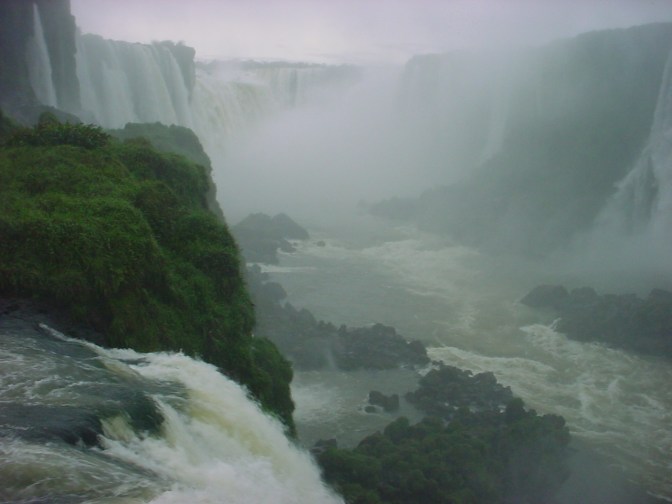
Looking towards La Garganta del Diablo – the Devil’s Throat, the most active part of the falls. Brazil is on the left, and Argentina is on the right. Only Victoria Falls in southern Africa and Niagara Falls between the United States and Canada are in the same league as Iguazu, but Iguazu holds the record for maximum flow by more than a factor of three.
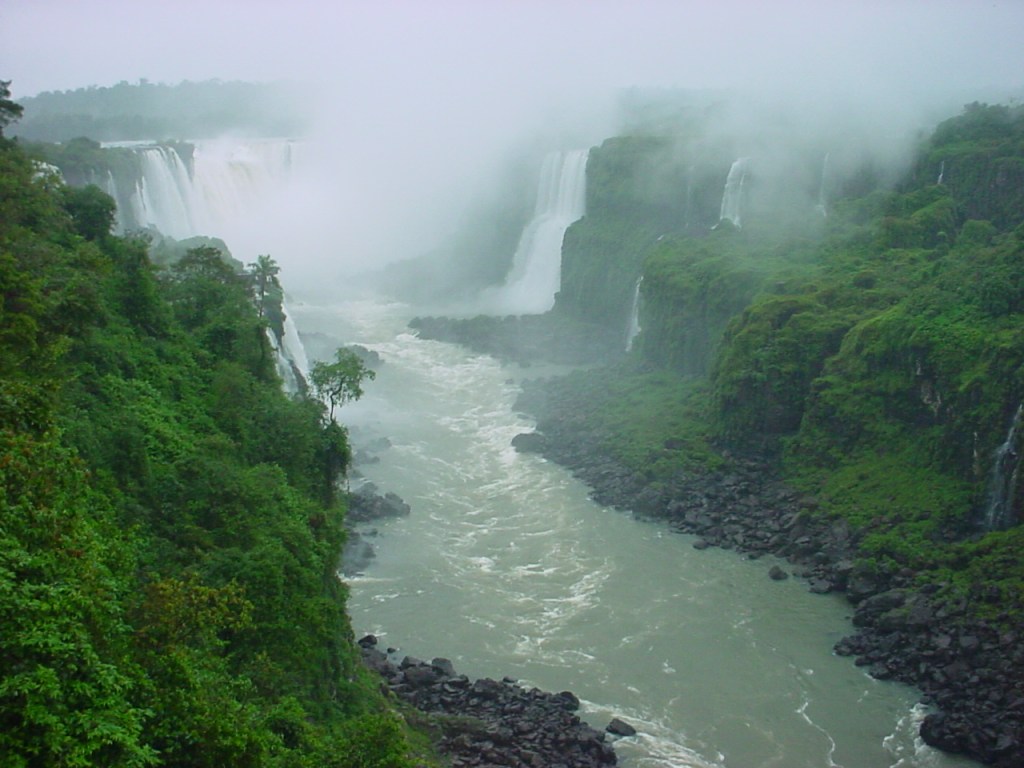
The view from Brazil into Argentina. As Argentina hosts the majority of the falls, the views from Brazil tend to be better, but more distant. The total length of the falls is 2.7 kilometres.

An encounter with a parrot! I don’t think this is the Norwegian Blue, but he’s definitely not an ex-parrot. And admittedly, this sighting was at the Iguaçu Bird Park.
Looking back towards La Garganta again, with the little walkway that took us right to the edge of the step halfway down the falls, which was as much of a watery falls experience as I could have hoped for.

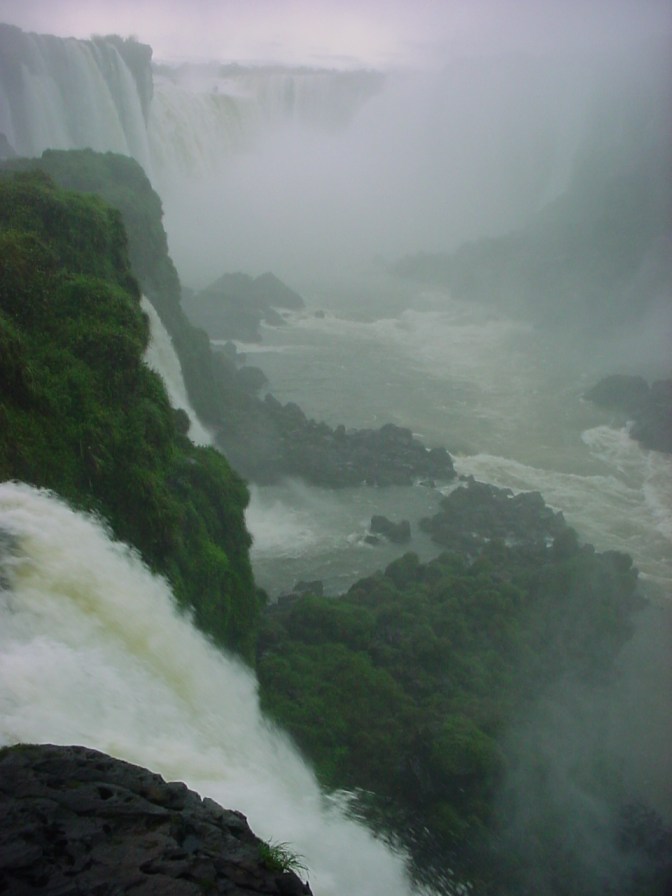
The view from the end of the walkway upstream towards the heaviest part of the falls. There was proper camera-disabling spray here, we all got soaked pretty quickly.
Back at the bird park, and toucans in their nests agree, Guinness is good for you. Try one for yourself and see, what one or toucan do! The top part of a toucan’s beak is filled with a spongy material so that it isn’t unbalanced and can still fly, we learned.


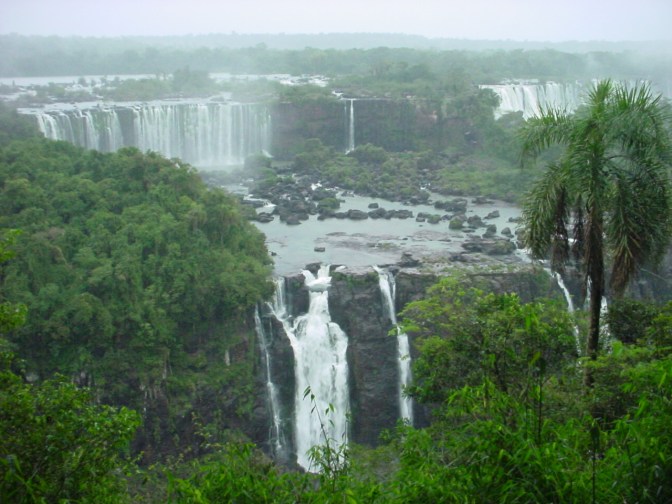
From higher up on the Brazilian side we could see more of the falls and get a clearer overview, although this still represents only a small length of the entire waterfall system. At this point it was almost threatening sunshine, too.
A smaller section of the falls in Argentina. Despite the rain, we had actually arrived during the drier season – there were postcards for sale that showed the falls with much more water cascading over.

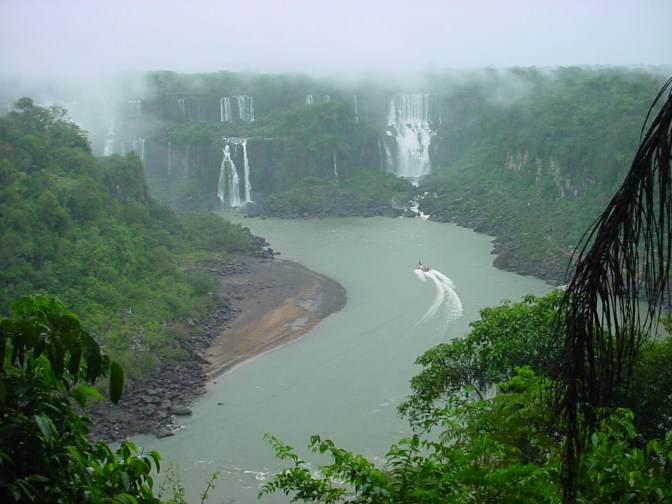
An occasional boat would zoom past up the river, hauling cheerful soggy tourists towards the Devil’s Throat.
Naturally we hopped onboard the next speedboat to head upriver for a bit more of a soaking ourselves, and it was clear that the river often runs much higher, judging by the bare darkened rock. The falls must be an order of magnitude all the more impressive when in spate.

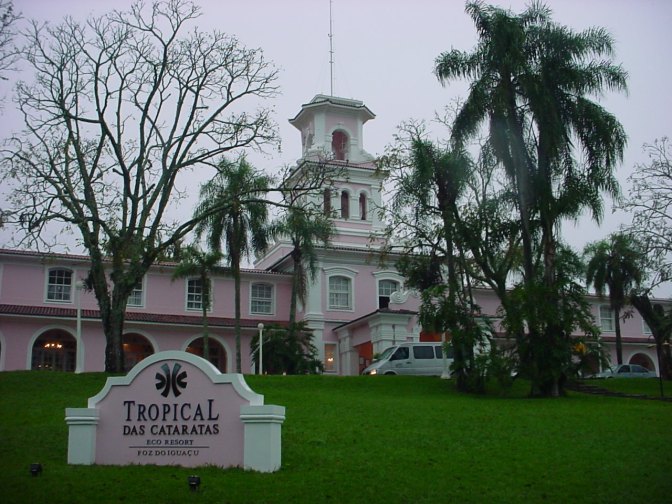
Back on dry land, we passed the swanky hotel Tropical das Cataratas in the Brazilian side of the park. Although I dare say it wasn’t quite as fancy as the Pousada Campestre where we stayed for merely a few coins per night. Since our visit the hotel has upped its game further, and joined the Belmond chain. Our campsite on the other hand seems to have vanished.
The city of Foz do Iguaçu sprang up almost overnight when work began on the nearby Itaipu dam. There was a slightly uneasy feel to the place – being a frontier town probably doesn’t help. It was difficult to locate any sort of nightlife, and once we’d seen the falls and the dam there was little more to entice us to stay any longer.

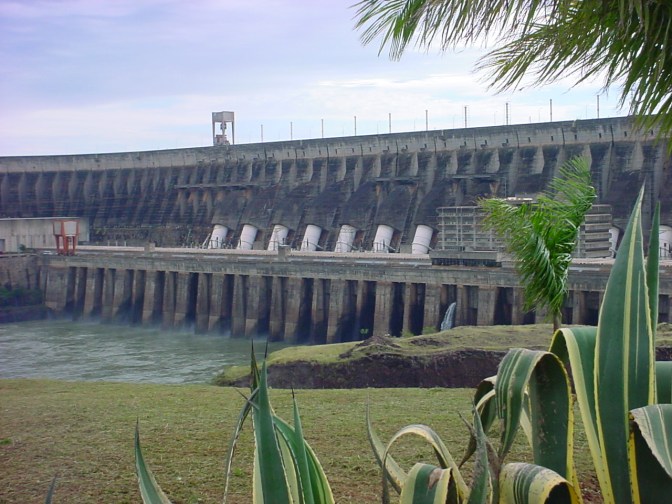
The other main event of the area, the Itaipu Dam, as seen here from the visitors’ gallery. The dam was a joint venture between Brazil and Paraguay, completed in 1984 after thirteen years of construction, to supply power to a quarter of Brazil and almost the entire country of Paraguay. From this distance it’s difficult to get a real sense of scale, the dam is 196 metres tall, about the same as a fifty-storey office building, and over seven kilometres across.
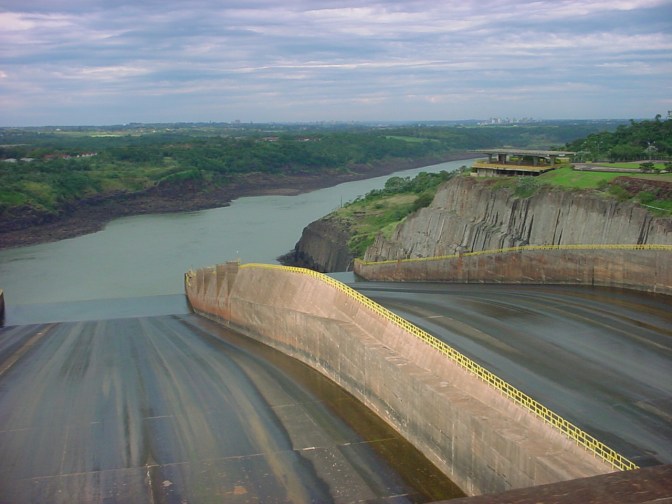
The tour bus took us across the humungous spillways which are occasionally opened to allow the Rio Parana to flow faster if necessary, but not on this day. When running at full capacity, they discharge forty times the rate of water as the average flow over the Iguazu Falls.

Closer view of the dam, the car next to the nearest white penstock gives a sense of scale. Like many major projects the Itaipu Dam was not without controversy, but for all the rainforest that disappeared beneath the reservoir, so much more was saved from burning for conventional power generation. A few years after our visit, China’s Three Gorges Dam came online and took the title of world’s largest power plant.
Created 2006 | Updated 2018, 2025
 SnapHappyRoss
Leave a comment